Hi everyone, welcome back to World of Dhiyara. In this video, I share four fun dice and card games that help children practise basic maths skills such as place value, addition, subtraction, and comparing numbers. These are simple ideas that you can customise for your child’s age and learning pace: make the numbers easier or add a little more challenge.
Before you begin
You will need dice for the first two games and a regular pack of playing cards for the last two. At least two players makes the games more enjoyable, but you can include siblings, friends, parents, or a larger group.
1. Roll and Place: practise place value
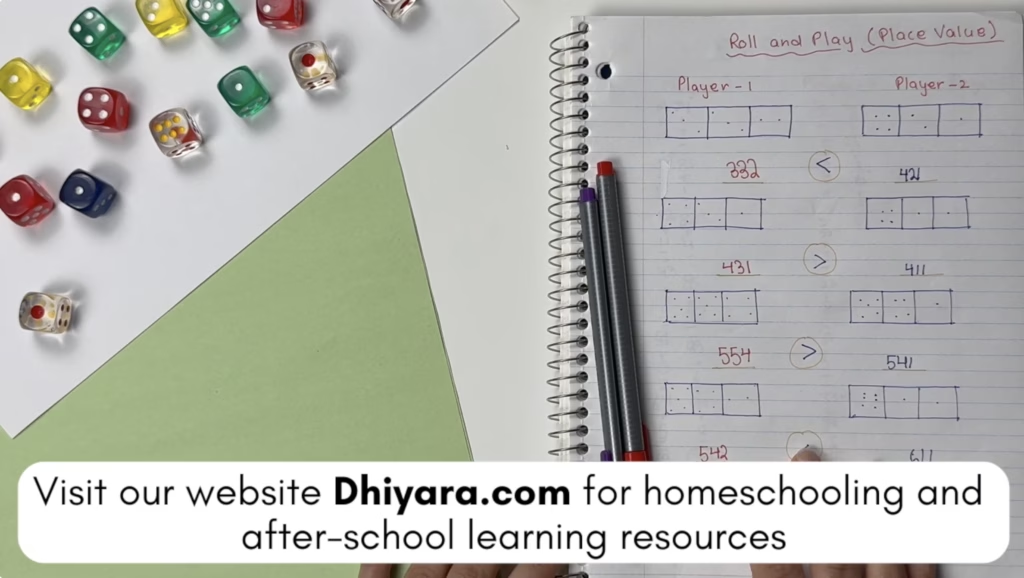
For a three-digit number, draw three boxes and use three dice. For a two-digit number, use two boxes and two dice. Players take turns rolling, then arrange the digits to make the greatest number possible. For example, if the dice show 5, 5, and 2, the greatest number is 552. As an optional extra, ask your child to draw the dice dots in the boxes before writing the number.
After everyone has made a number, compare the numbers and use the correct greater-than or less-than sign. Two players are enough, but you can add four or five players for a lively group game.
2. Roll Three Times and Make 100
Use two dice. Each player rolls the dice up to three times and makes the largest two-digit number from each roll. For example, 5 and 4 can become 54 rather than 45. Add the numbers as you go and try to reach 100. If a player reaches 100 after two rolls, they can stop; otherwise, they can use the third roll. You can decide a winner for each round or play several rounds and see who reaches 100 most often.
3. Flip Cards and Add to 100
Use a regular pack of playing cards and take turns flipping one card at a time. Each player writes the number they flip and keeps adding to their running total. For example, 8 + 11 = 19, then add the next card to the total. The first player to reach 100 wins. With two players, take turns; with more players, let everyone flip a card in each round.
4. Flip Two Cards and Make the Greatest Number
For the two-digit version, remove the 10 through 13 cards and keep the single-digit cards. Each player flips two cards together and arranges them to make the greatest number: 9 and 8 become 98 rather than 89, and 2 and 1 become 21 rather than 12. Write each score, then add the scores over several rounds. For a three-digit version, keep a wider range of cards and make a three-digit number instead.
Keep it playful
These four games practise important maths ideas while children play together. They work at home, with siblings, or as an activity for a children’s party. Adjust the number of boxes, the target number, or the number of rounds to suit your child. If you try one of the games, I would love to hear which one your child enjoyed most.
For more hands-on practice, explore my printable resources.